


What if your next hands-on break didn’t have to involve clicking, squeezing, or spinning the same little toy again and again? Fidget toys for adults come in plenty of styles, but choosing one can feel surprisingly tricky when textures, sounds, and sensory experiences all differ. A satisfying desk companion for one person might feel distracting in a quiet office or shared space.
It’s fair to want something that feels good in your hands and fits your everyday routine. The right choice depends on what you’re after: a simple repeated motion, a more varied tactile experience, or a little creative play. No single style suits everyone, and a fidget toy doesn’t have to be your only option for a screen-free pause.
In this guide, we’ll compare popular fidget toy styles and what makes each one appealing, from discreet sensory rings to tactile putty. You’ll also discover Scene Stickers as a creative alternative: peel and place small stickers onto a background, then watch a tiny illustrated world come alive piece by piece. It’s a portable, beginner-friendly activity for your next me-time moment, especially if making something feels more satisfying than repetitive fidgeting. Whether you’re taking a break at home in Singapore, Jakarta, or elsewhere in Malaysia or Indonesia, the same simple question helps: what kind of hands-on moment do you feel like today?
Key Takeaways
- Compare fidget toys for adults by the interaction you enjoy, from squeezing and spinning to clicking, rolling, or exploring textures.
- Consider sound, size, and discretion alongside sensation to find an option that feels comfortable at work, at home, or on the go.
- Try a simple routine: choose a setting, pick one interaction, give it a brief try, and notice whether it suits you and those nearby.
- If repetition isn’t your thing, try a creative screen-free activity that gives you something visual to arrange and complete.
- Scene Stickers turn small placements into a miniature illustrated world, with possibilities for solo time, journaling, or scrapbooking.
What Are Fidget Toys for Adults, and What Makes Them Appealing?
A fidget toy is an object someone manipulates for tactile, visual, or repetitive engagement. It’s for everyday hands-on play, not a medical treatment. The term covers plenty of objects, from something you squeeze between your fingers to a small gadget you turn or move. The appeal is personal: one person might enjoy a familiar motion during a break, while another prefers exploring an interesting texture or watching a moving part.
Adults may reach for fidget toys for adults because they enjoy the sensory experience, like having a small routine, or want something to handle during a quiet moment. That doesn’t mean the same item suits everyone, or that using one promises a particular change in focus, stress, or well-being. Think of it as one possible way to add a little tactile interest to an ordinary day. For a general overview of the fidget toy, including the range of objects people use, Wikipedia offers a useful starting point.
Common fidget toy styles adults may encounter
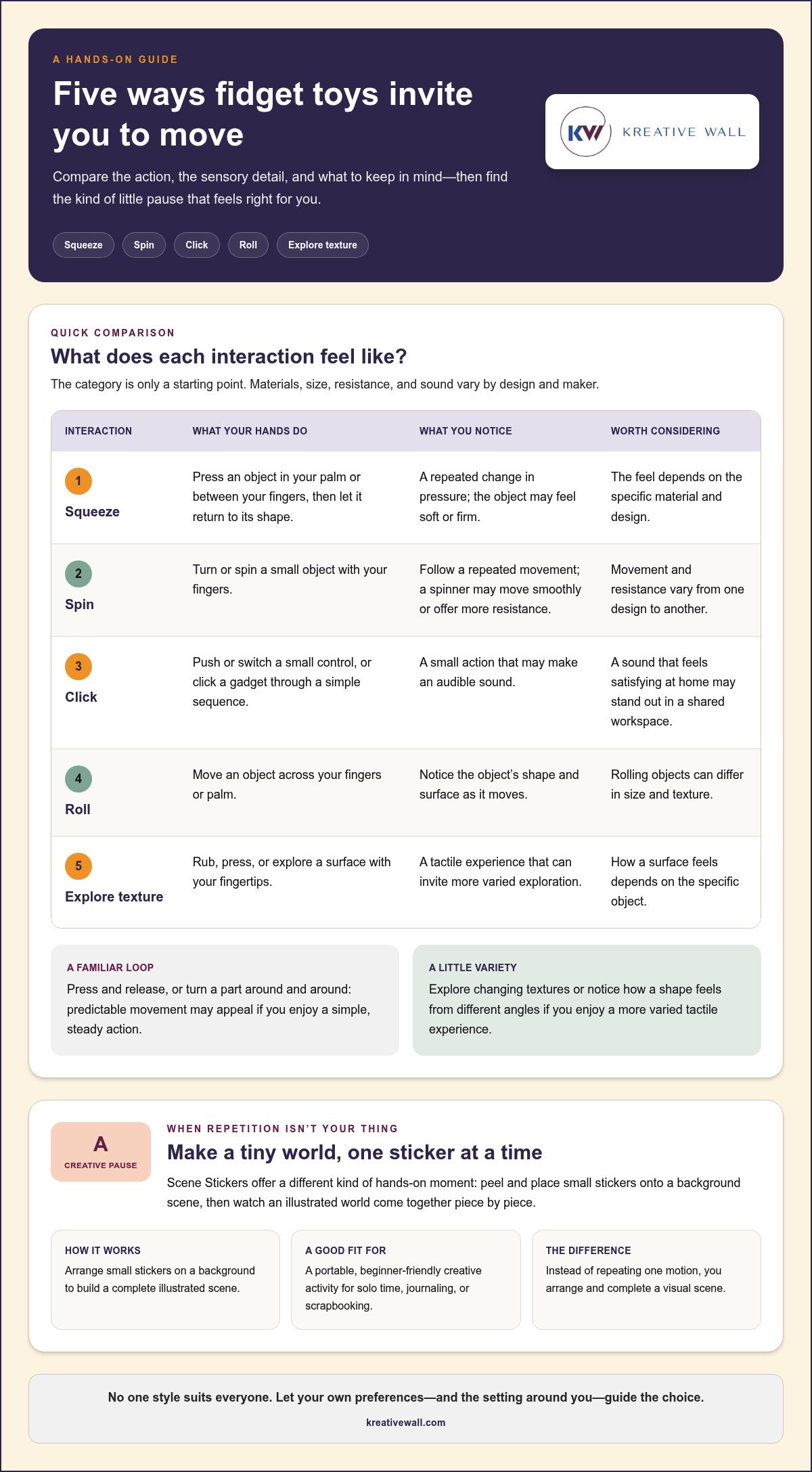
Fidget toys come in broad categories, and their appeal often starts with the movement they invite. A squeeze object is pressed and released; a rotating toy is turned between the fingers or spun; small manipulable gadgets might be clicked, rolled, slid, or shifted from one position to another. These labels describe the action, not exactly how a particular object will feel.
- Squeeze objects: Press the item in your palm or between your fingers, then let it return to its shape.
- Rotating toys: Turn or spin a small object with your fingers and enjoy the repeated movement.
- Manipulable gadgets: Click, slide, roll, or reposition small parts in a simple sequence.
Even within one category, the experience can vary. Materials, size, resistance, and sound depend on the specific design and maker, so “squeezable” or “clickable” only tells you part of the story. If you’re comparing items, look for details about how they move and what they’re made from instead of relying on the category name alone.
Why adults enjoy tactile activities
Hands-on interaction gives you something concrete to notice: a texture beneath your fingertips, a repeated motion, a gentle resistance, or a visual change as a part moves. For some adults, that small sensory detail makes an ordinary pause feel more engaging; others simply enjoy the pleasing rhythm of doing something with their hands. There’s no single right reason to like a fidget.
Preferences can be subtle or playful. One person may want a quiet object with a small, discreet movement, while another might enjoy more obvious sensory feedback. Setting matters, too: a sound that feels satisfying at home may stand out in a shared workspace. Pay attention to what feels comfortable for you and considerate of people nearby.
And if repetitive motions aren’t quite your style, hands-on fun can take a more creative turn. Some screen-free activities offer not only tactile interaction but also a small result to arrange, build, or complete. That’s a different kind of satisfaction, with room for curiosity and personal expression.
How Fidget Toys Differ by Sensation, Movement, and Interaction
A toy’s category gives you a starting point, but the small details shape how it feels in use. A squeeze toy may feel soft or firm; a spinner may move smoothly or offer more resistance. Clicks can be quiet or noticeable, and rolling objects vary in size and texture. Those differences depend on the design and maker, so two items with the same basic action may still feel quite different.
Use this quick comparison to identify the interaction that sounds most appealing. Then consider sound, movement, and feel as part of the whole experience:
- Squeeze: Press and release an object for a repeated change in pressure.
- Spin: Set a part rotating with your fingers and follow its movement.
- Click: Push or switch a small control, which may make an audible sound.
- Roll: Move an object across your fingers or palm, noticing its shape and surface.
- Texture-based: Rub, press, or explore a surface with your fingertips.
This is a map, not a ranking. No sensation is universally more calming, focusing, or suitable for adults. Fraser’s overview of fidget toys for ADHD and autism discusses fidgeting in relation to sensory needs, but individual experiences vary. For everyday browsing, let your own preferences and setting guide you.
Repetitive movement versus tactile exploration
Some interactions follow a familiar loop: press, release, repeat, or turn a part around and around. Others invite you to explore, shifting your fingers across changing textures or noticing how a shape feels from different angles. Predictable movement may appeal if you like a simple, steady action; tactile exploration may suit you better if you enjoy variety. Neither style guarantees a change in mood or concentration. Notice which one feels pleasant rather than assuming a particular movement will work for everyone.
Quiet, visible, and more expressive interactions
A compact object that moves under a hand may be less noticeable than one with a larger gesture, but discretion depends on its design and how you use it. Clicking and spinning can also create sounds, from barely audible to distracting in a quiet room. If you share a workspace, consider the people nearby and choose a movement that feels considerate. Visual appeal is its own factor: a bright, playful toy may catch your eye without feeling especially interesting to touch, while a plain-looking object may offer a texture you enjoy.
If you find yourself wanting more than a repeated motion, a creative activity can add arranging and making to that hands-on moment. Scene Stickers for creative me-time offer a screen-free alternative: place small stickers on a background scene and watch an illustrated world take shape, piece by piece.
How to Compare Fidget Toys for Work, Home, and Travel
The same object can feel just right in one setting and awkward in another. A click that fades into the background at home may stand out in a quiet meeting, while a larger item might be easy to keep nearby at a desk but less convenient to carry. Compare options by where you’ll use them, rather than assuming one style works everywhere.
Use this guide as a starting point, not a universal recommendation. The best fit depends on your preferences, the people around you, and the details of the specific item.
Setting
Interaction to consider
Sound
Portability
Discretion
Work or shared space
A small movement you can manage while seated, such as rolling or pressing.
Consider whether clicks or other sounds could interrupt nearby people.
Think about whether it fits comfortably beside your usual desk items.
Choose an interaction that stays unobtrusive during everyday tasks.
Home
Choose based on the movement or tactile experience you enjoy during a break.
There may be more room for sounds or larger gestures, depending on your household.
Storage may matter more than carrying convenience.
Consider where you’ll keep it so it’s easy to pick up and put away.
Travel
A simple movement may be easier to manage in a compact space.
Sound can feel more noticeable around fellow passengers.
Consider how easily the item fits into your bag or pocket.
Check that handling it feels practical for the journey and where you’ll be seated.
Quick takeaway: Let the setting guide your priorities. Shared spaces call for more attention to sound and discretion, home allows you to focus on personal preference, and travel makes portability part of the picture.
Choosing an option for shared or quiet spaces
If you work near others or spend time in quiet rooms, start by considering how an object sounds during normal use. A click or repeated movement may carry farther than expected, and no design should be assumed completely silent. Also consider whether you can handle it without interrupting what you’re doing or drawing attention. A brief trial in a similar setting can reveal more than a product category alone.
Choosing an option for home or on-the-go use
At home, think about where the item will live between breaks, whether its surface needs regular cleaning, and how often you expect to reach for it. For a commute or trip, consider how compact it is, how it will be stored, and whether handling it suits the space and journey. Size, material, care needs, and movement vary by product, so fidget toys for adults aren’t automatically travel-friendly just because they’re small. A compact creative activity may be another option for a journey or a quiet moment at home.
If you’d rather bring a little making into your screen-free downtime, explore Scene Stickers for creative breaks, a playful option for building a miniature illustrated world one sticker at a time.
How to Find a Fidget Routine That Feels Comfortable
A hands-on break should fit your moment, not turn into another task to get right. Rather than expecting fidget toys for adults to feel the same for everyone, treat choosing one as a small experiment. The aim is simply to notice whether the movement feels comfortable, suits the setting, and leaves you free to carry on with what you’re doing.
Try this easy sequence:
- Identify your setting. Think about whether you’re at home, in a shared workspace, or somewhere you need to keep your hands and attention available.
- Choose one interaction. Start with a movement or texture that sounds appealing, and consider how much sound or motion feels appropriate there.
- Try it briefly. Use it during an ordinary pause rather than expecting it to change how you feel or work.
- Reassess. Notice your own comfort and whether the activity feels distracting to you or people nearby. Adjust, switch, or set it aside.
There’s no need to build a strict routine around it. A tactile activity can be an optional part of an everyday break, and it’s fine if your preference changes with the place, task, or day. A quick check-in keeps the experience personal and considerate.
A simple way to test an activity
Start with the setting: a quiet room may call for less sound and movement than a relaxed moment at home. Try one interaction at a time so you can tell what you actually enjoy, rather than juggling several sensations at once. After a brief try, ask yourself: Does this feel comfortable? Can I still do what I intended? Is it noticeable to someone nearby? If it feels awkward, distracting, or uncomfortable, switch activities. No need to force a fit.
When repetitive fidgeting is not your style
Maybe you’d rather make, arrange, or complete something than repeat one small motion. Journaling and sticker play can offer a different kind of screen-free pause, but they’re creative pastimes, not fidget devices. For example, screen-free mindful journaling ideas can help you turn a blank page into a personal little ritual, with words and images arranged at your own pace.
For a more visual activity, Scene Stickers let you place small stickers onto a background scene and watch an illustrated world come together piece by piece. The peel-and-place process offers a clear sense of making, whether you enjoy it on your own or add the finished scene to a journal or scrapbook. Curious about collecting as part of a creative hobby? Explore this creative sticker collecting guidance for ideas on getting started.
If you’re in the mood to make rather than repeat, explore Scene Stickers for your next screen-free break and find a tiny world waiting to be built.
Scene Stickers: A Creative, Screen-Free Alternative for Adults
If repetitive motion isn’t quite your thing, a hands-on activity can still make a satisfying screen-free pause. Scene Stickers offer a creative alternative to fidget toys: you arrange small illustrated details on a background scene to create a complete picture. Rather than repeating one movement, you make choices about placement and composition, turning separate elements into a tiny world with its own little story.
The fun is in the gradual transformation. A detail that seems small on its own can change how the whole scene feels once it finds its place. You can take your time, follow your eye, and enjoy a creative activity that doesn’t ask for specialist craft skills. It’s a playful way to make room for curiosity in an otherwise busy day, a little pocket of calm in the middle of the routine.
A tiny world-building activity, one sticker at a time
Begin with the background, then look over the smaller details and decide what catches your eye. Peel a sticker, place it where you think it belongs, and continue arranging the scene at your own pace. You can follow your first instinct or pause to consider how each addition changes the composition. There’s no need to be an experienced crafter; the process is beginner-friendly and satisfying to explore. For more creative context, see the Scene Stickers world-building guide.
Creative ways adults can enjoy Scene Stickers
Make the activity your own. Settle in for solo me-time, bring it to your creative desk, or use a finished scene as a decorative accent in a journal or scrapbook. The portable format makes it easy to keep a creative pastime close at hand, and collecting different scenes can add a fresh theme to your next session. Scene Stickers can also make a thoughtful gift for a stationery lover who enjoys playful, hands-on hobbies.
- For journaling: Pair a scene with a reflection, a favourite memory, or a place you’d love to visit.
- For scrapbooking: Build a page around the scene’s details and use it to give a memory its own visual setting.
- For a desk break: Keep a scene nearby for a creative pause that invites you to arrange and experiment.
- For gifting: Choose Scene Stickers for someone who enjoys stationery, collecting, or imaginative solo activities.
If you’re after a playful alternative to fidget toys for adults, let your curiosity take the lead. Explore Scene Stickers at KreativeWall.com and find a creative escape that feels just right for you.
Choose a Hands-On Break That Feels Like You
Your next break doesn’t need a perfect plan. Notice what you feel like doing in the moment: a simple repeated motion, a bit of sensory play, or something that lets you make small creative choices. Your preferences can shift with your surroundings and your day, so give yourself room to try different kinds of me-time without turning them into another task.
If you’re still weighing fidget toys for adults, let comfort be your guide. Choose an activity that feels enjoyable and fits the time you have, whether you’re taking a quick pause or settling in for a longer creative session. Small moments of play can be personal, low-pressure, and entirely your own.
Ready to follow a new idea? Explore Scene Stickers and find your next creative escape. Pick the design that sparks your imagination, and see where your next little creative adventure takes you.
Frequently Asked Questions
Do fidget toys work for adults?
They can be enjoyable for adults, but whether a particular toy suits you is personal. One person might like turning a small object during a phone call, while another may find that movement distracting. Try an interaction during a low-pressure moment, such as while listening to a familiar podcast, and notice whether it feels comfortable. Fidget toys for adults are an everyday option, not a guaranteed way to change focus or mood.
What is the quietest type of fidget toy for work?
There’s no type that’s guaranteed to be silent, since materials and construction affect sound. For a shared office, consider a simple interaction without clicking parts, such as gentle pressing or exploring a texture. Test it in a quiet moment before using it during a meeting. If you can hear repeated sounds across your desk, nearby colleagues may hear them too, so save that option for a more suitable setting.
Are fidget toys only for people with ADHD?
No. Adults may choose fidget toys for different reasons, including enjoying a particular texture or having something to handle during a pause. You don’t need a diagnosis to enjoy a sensory object, and liking one doesn’t indicate a condition. Preferences vary, so focus on whether the item suits your own routine. If you’re considering a fidget tool for a specific health-related need, a qualified professional can offer guidance suited to your circumstances.
Can a fidget toy replace scrolling on my phone?
It can give your hands something else to do during a moment you’d otherwise spend scrolling, but it won’t automatically replace a phone habit. Try leaving your phone aside during one short break and choosing a tactile activity instead. If you want something with a visible result, a journal page or small creative project may feel more engaging than a repeated movement. Choose what fits the moment, without expecting a perfect swap.
How should I clean a fidget toy?
Check the care instructions provided for that specific item first, since cleaning methods depend on its material and construction. If it has electronic or moving components, avoid soaking it unless its instructions explicitly say that’s suitable. For a shared object, cleaning it between users can be a sensible everyday habit. Don’t apply cleaners, heat, or water without checking the product guidance, as the wrong method could damage its surface or parts.
What can I try if I do not enjoy traditional fidget toys?
Try a hands-on creative activity that gives you a different kind of task. For example, add journaling stickers to a page to mark a favourite memory, or arrange a few decorative details around a written reflection. If you’d rather keep the page intact, use a Scene Sticker Book for a portable creative session. These options let you experiment with colour, placement, and personal themes without relying on a repeated fidget motion.

Article by
Kreative Wall
Kreative Wall is your Scene Sticker and creative stationery specialist, curating joyful Scene Stickers, Landscape Stickers, journaling stickers, scrapbook stickers, and cute decorative finds for creative souls who love tiny worlds, big joy, and a little escape from the oh-so-serious world.